Versa
We launched a playable daily word game and began measuring how people use it.
I co-founded Dear Barry Games with my mum and launched Versa, a daily word game built around antonyms and the multiple meanings of one answer.
Promotion so far has been limited to two LinkedIn posts and sharing with family and friends. The first 30 days therefore give me an early product baseline, not evidence of scale.
Generating puzzles was easy. Knowing which ones were good enough to publish was harder.
I built a pipeline that combines deterministic quality gates, same or near-family and cross-family model evaluation, human review, curation, and post-launch measurement.
Hard gates catch structural failures before publication. Reviewers can still override strong model scores when an antonym is wrong, the meanings are too similar, or a clue gives away the answer.
The review system had to work for the people doing the review.
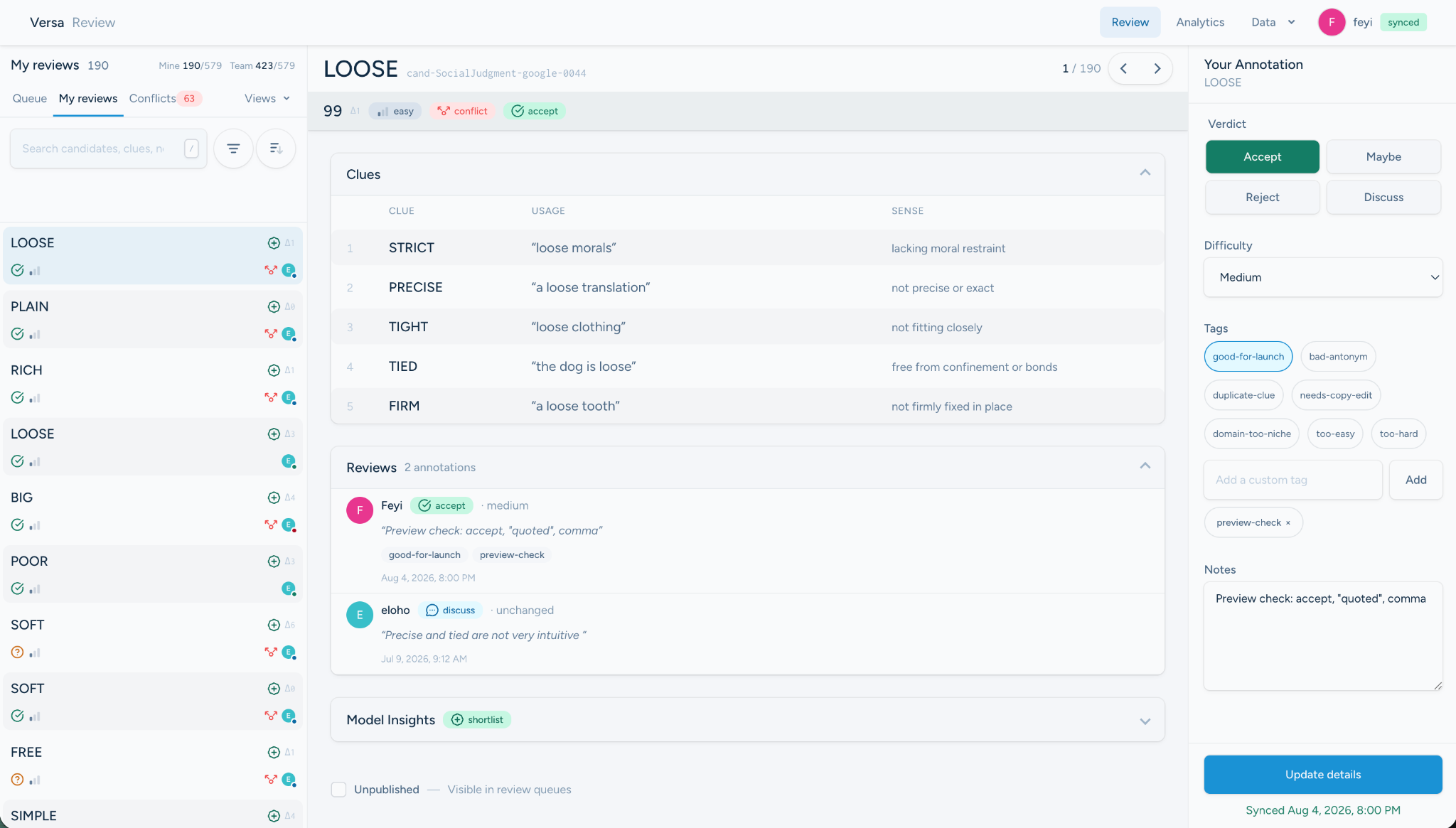
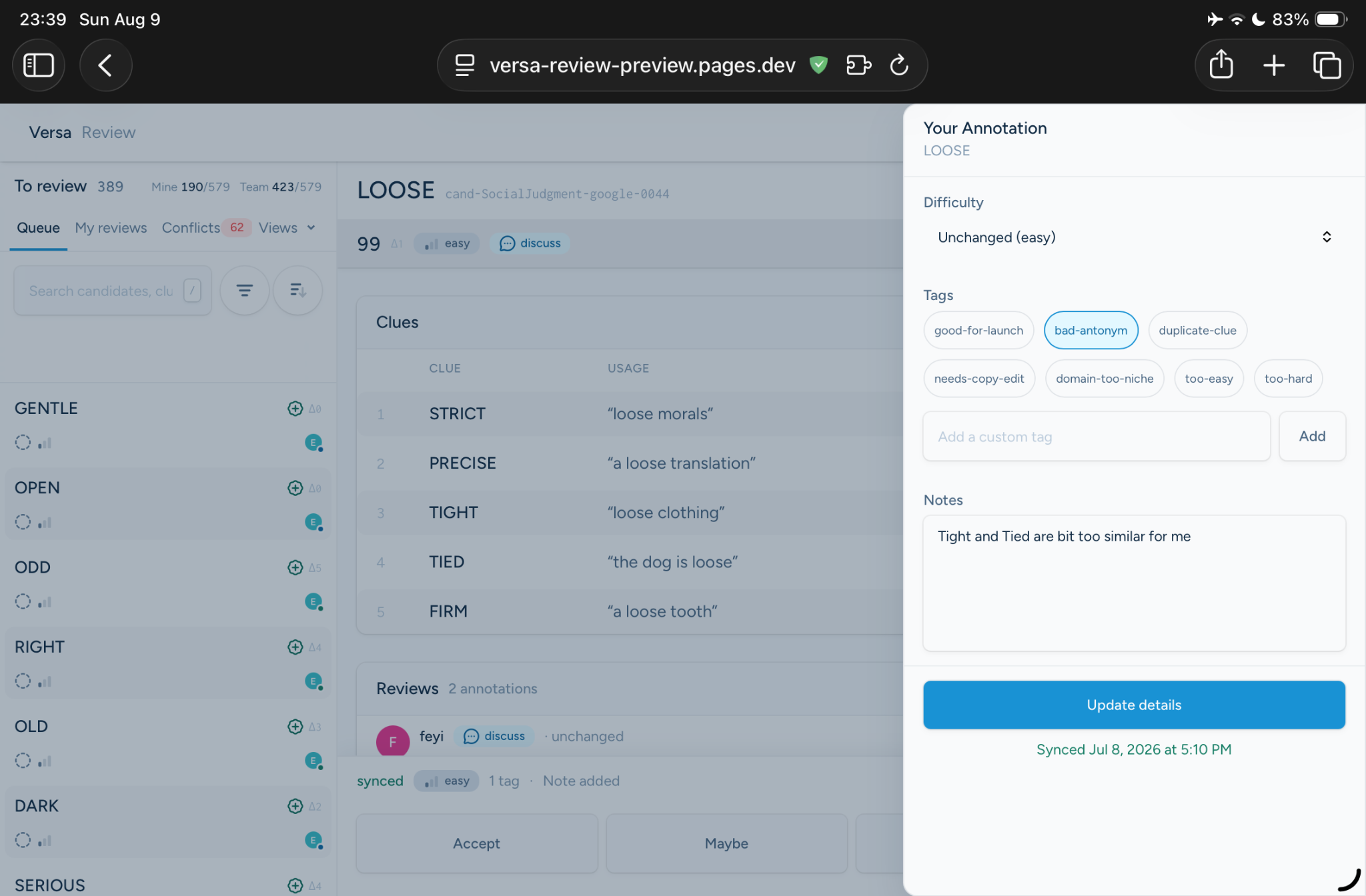
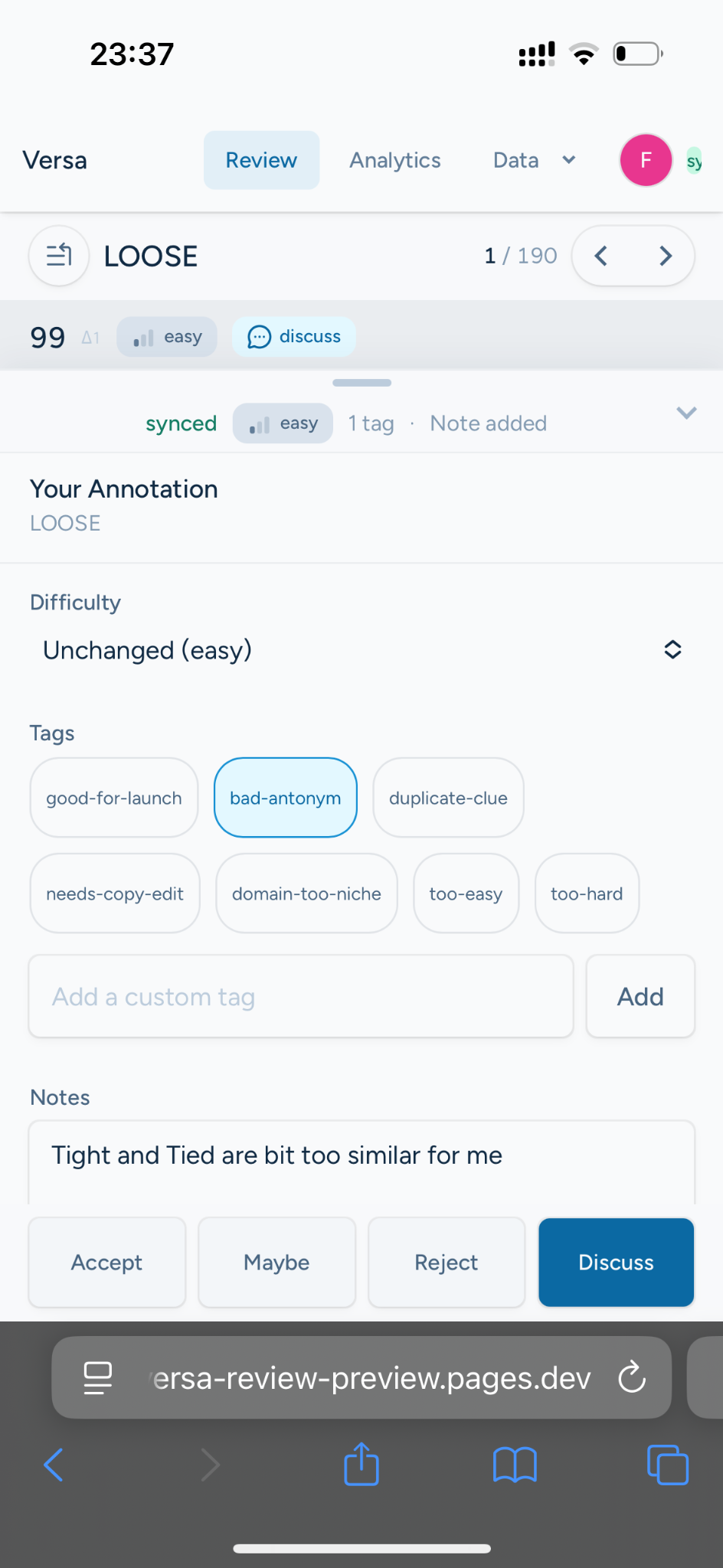
Reviewers inspect clues and model evidence, record a verdict, change difficulty, add quality tags, leave notes, and resolve disagreements.
My parents reviewed real content, often on their phones. I rebuilt Versa Review around the devices they used: a multi-panel desktop view, tablet panels, and a focused queue → candidate → annotation flow on phones.
One workflow, adapted to each screen
The first batch exposed problems in both the prompts and the generation architecture.
Reviewing the prompts more carefully before a large run would have saved time and money. Each stage also needs its own evaluation so a failure can be traced to generation, judging, curation, or delivery.
The duplicate analysis found only 445 distinct answers across 1,408 candidates. Parallel agents produced 963 excess candidates beyond the first occurrence of each answer, even though every ordered clue sequence was unique. The system created variation, but far too much of it converged on the same target words.
The next iteration is a smaller, measured experiment.
I will revise the prompt using observed failures, then test a small batch against the current shortlist rate before paying for another large run.
I am still evaluating the best generation approach. One option is to compare a few models across easy, medium, and hard puzzles, auto-grade the results, and choose the best quality-to-cost tradeoff.
Working on a hard product problem?
I’m exploring GTM Strategy, AI Product, Product Strategy, and Forward Deployed roles.