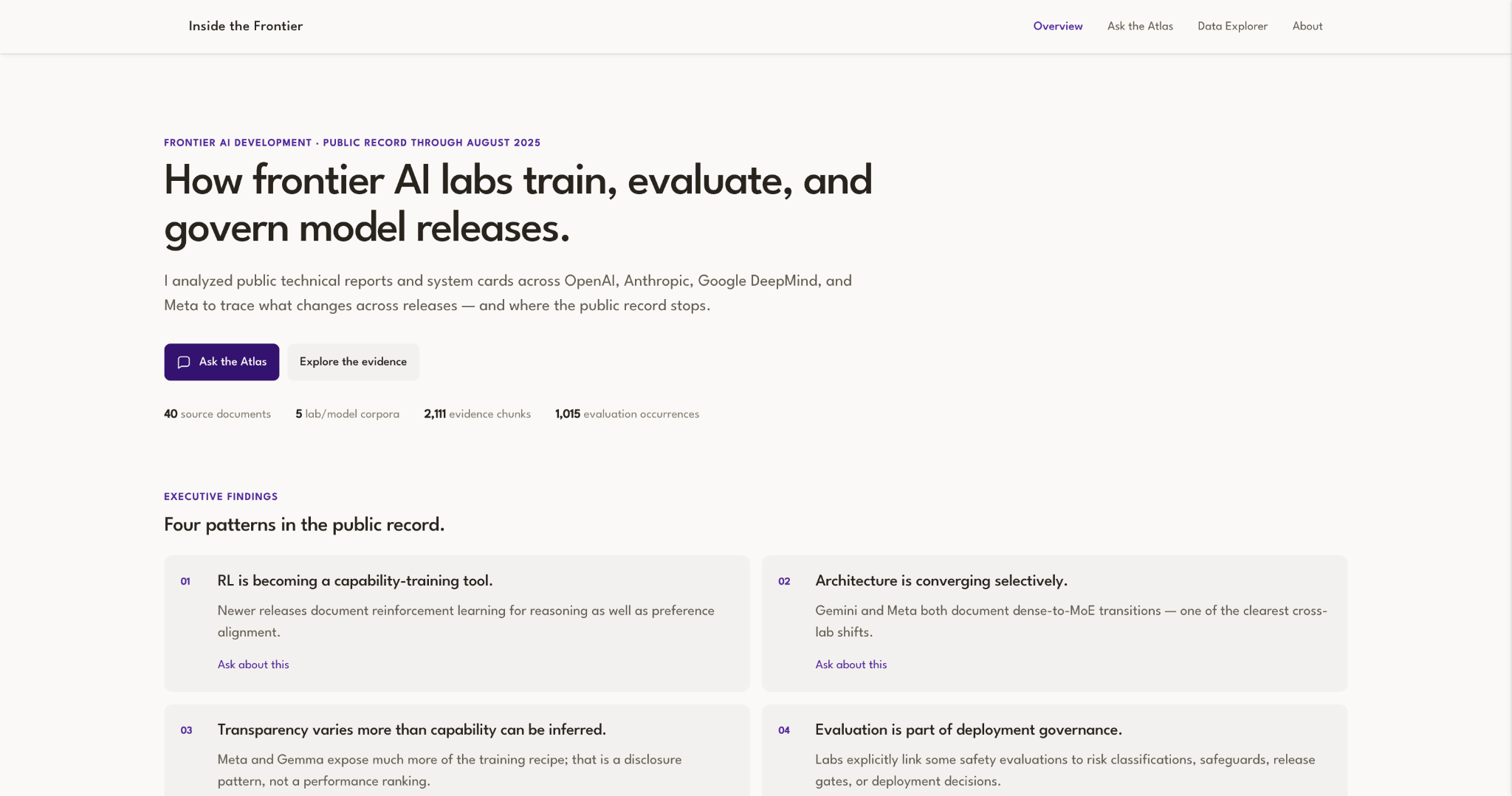
The Question
Frontier AI reports contain a large amount of technical evidence, but the evidence is difficult to compare across labs. A benchmark score can hide changes in prompts, tools, attempt budgets, graders, thresholds, and release context.
I wanted to answer a more useful strategy question:
How do leading AI labs measure capability and risk, and how does that evidence connect to model release decisions?
I focused on reviewed public sources from OpenAI, Anthropic, Google DeepMind, Gemma, and Meta. The deployed source library is frozen at August 2025 so every claim has a defined evidence boundary.
I built the evidence system before I trusted the synthesis.
The research pipeline separates collection, extraction, comparison, and synthesis. This makes it easier to catch a confident conclusion that is not supported by the record.
The structured evaluation layer records one occurrence per evaluation × lab × model/release. I also built 1,015 protocol fingerprints so the comparison could include how an evaluation was run, not only its name or score.
For the reader product, questions retrieve relevant chunks from the reviewed source library. Answers cite the supporting chunks, and the user can open the source excerpt instead of trusting a summary with no traceability.
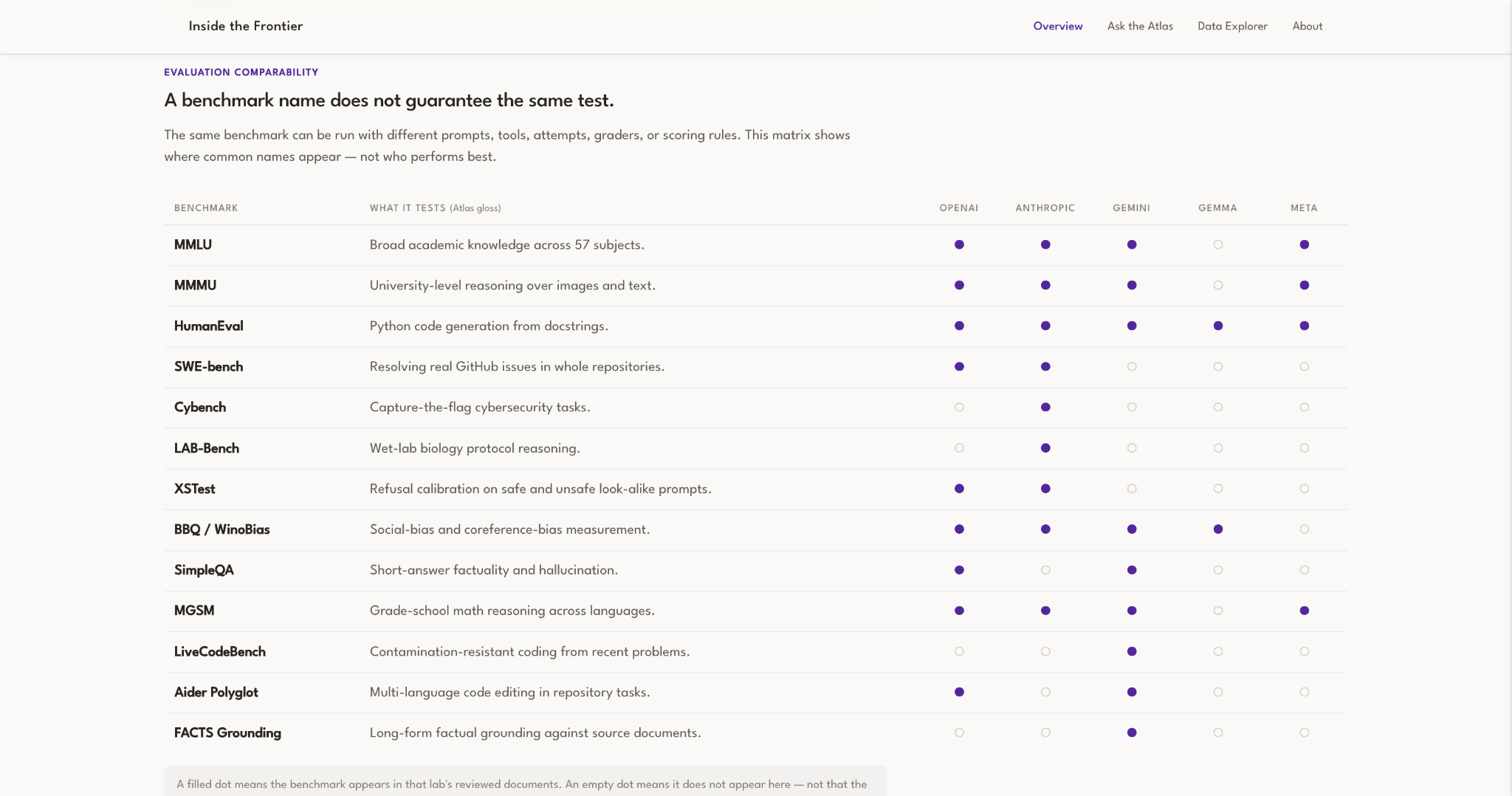
Same benchmark did not mean same test.
This became the most important methodological finding. I compared 30 exact-benchmark reuse cases, 19 same-construct comparisons, and 24 protocol-drift cases.
GPQA
OpenAI reported pass@1 and higher-compute consensus or reranking variants. Anthropic reported majority voting across repeated rollouts. Gemini reported pass@1. The results are all called GPQA accuracy, but they are not the same measurement.
SWE-bench Verified
OpenAI and Anthropic used different scaffolds, tools, attempt counts, and grading setups. The benchmark name stayed the same while the test conditions changed.
Cyber CTFs
Attempt budgets ranged from pass@12 over 16 rollouts to pass@30 and at least one success across 10–50 attempts. More attempts can mechanically improve measured success.
The audit also exposed a disclosure problem. Across the 1,015 fingerprints, attempts or pass@k were documented on about 14%, uncertainty on 6%, participant details on 6.5%, tools or harness on 14%, and thresholds on 17%.
Strategy implication: benchmark rankings can look more precise than the underlying evidence allows. Protocol detail changes what a score means.
What the public record showed
The goal was not to rank labs. It was to identify patterns that are supported across the reviewed record and separate them from disclosure differences.
Evaluation is part of deployment governance.
The lab profiles connect some safety and capability evaluations to risk classifications, safeguards, release gates, or deployment decisions.
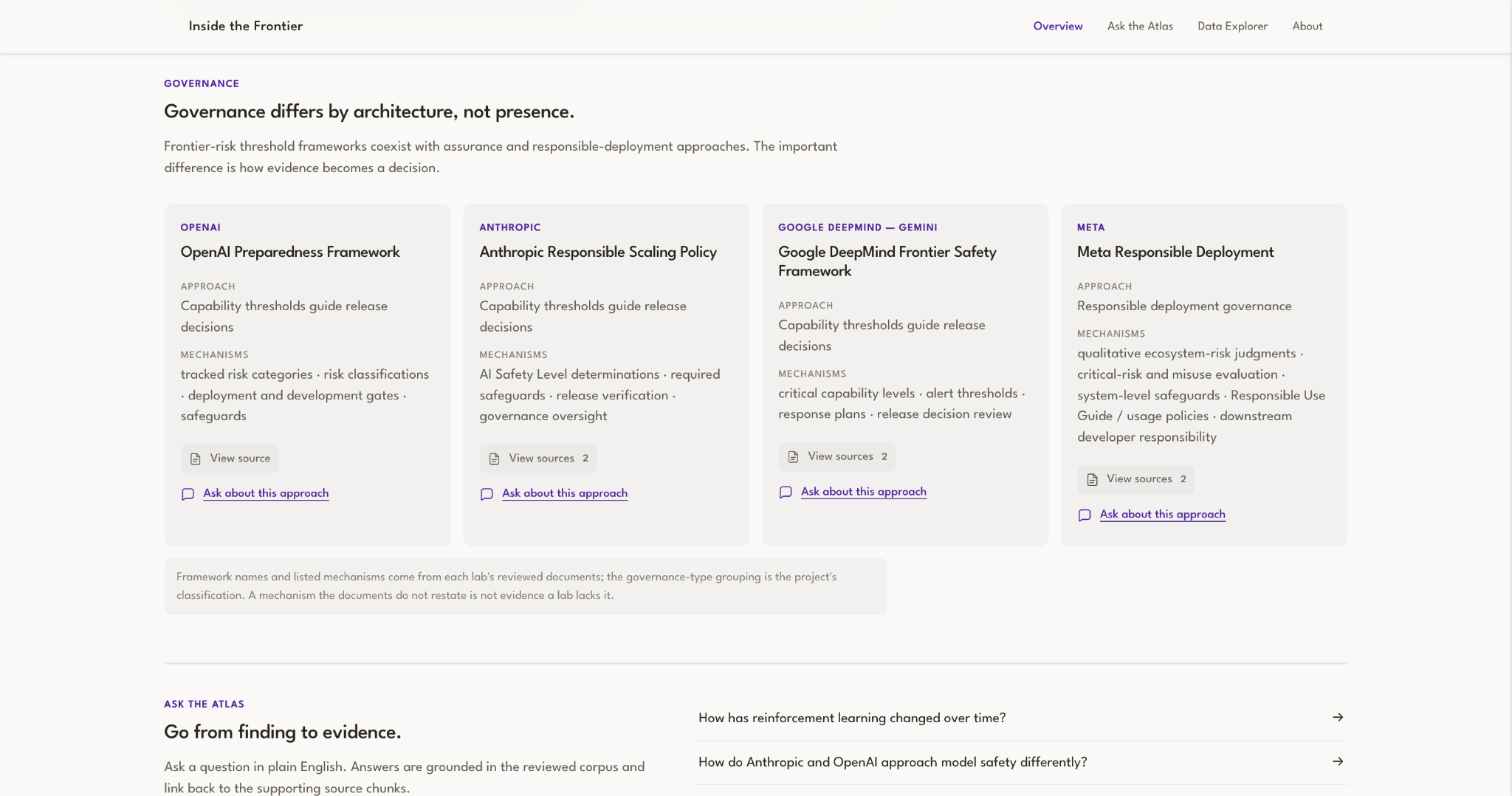
Governance architectures differ by kind.
OpenAI, Anthropic, and Gemini use named capability-threshold frameworks. Meta documents qualitative ecosystem-risk judgments and responsible-deployment safeguards instead of the same threshold ladder.
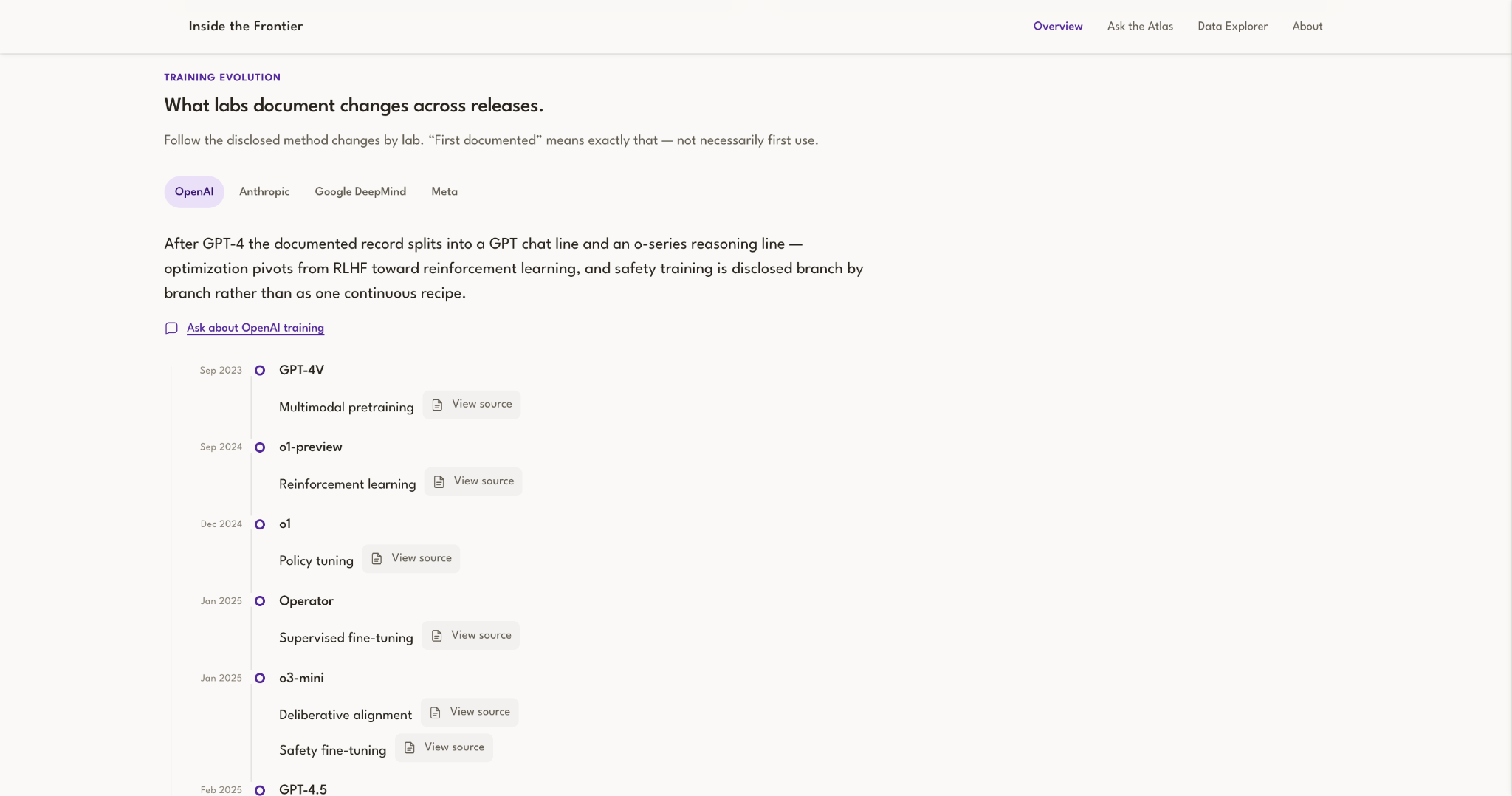
Training is converging selectively.
OpenAI and Gemini document reinforcement learning for reasoning. Gemini and Meta document dense-to-MoE transitions. Similar objectives do not imply identical training recipes.
Disclosure varies enough to distort comparison.
Only 29 of 93 training-method occurrences were classified as detailed. Most of those detailed disclosures came from the open-weight Gemma and Meta arms in this corpus.
The most useful result was a conclusion I had to change.
An early synthesis described Meta as lacking governance because the structured governance fields showed no named capability framework or numeric threshold crossings.
That conclusion was too broad.
From “governance gap” to “different governance architecture”
The source audit showed that Meta did run catastrophic and critical-risk evaluations, including CBRNE and cyber work. It also made qualitative, evaluation-dependent release judgments and shipped system-level safeguards such as Llama Guard, Prompt Guard, and Code Shield.
What the corpus did not show was a named frontier-capability ladder comparable to Anthropic ASLs, OpenAI Preparedness bands, or Gemini Critical Capability Levels.
The correction mattered because the first interpretation confused a missing field with a missing practice. The final finding became:
Two governance architectures, not a governance gap. The difference is how evaluation evidence becomes a release decision, not whether governance exists.
This became a rule for the whole project: “not documented in the corpus” is a disclosure statement, not proof of absence.
I turned the research system into a grounded reader.
The research artifacts were useful to me, but they were still difficult for a non-researcher to navigate. I reduced the product to three useful ways to work with the evidence.
Ask the Atlas
Ask a plain-language question. The answer uses only the reviewed source library and cites the evidence chunks it used.
Inspect the source
Open the supporting excerpt, copy the citation, and see the source context instead of treating the answer as an authority.
Explore the catalog
Search evaluations by lab, test type, and model release, then inspect the available setup, scoring, metrics, thresholds, and source evidence.
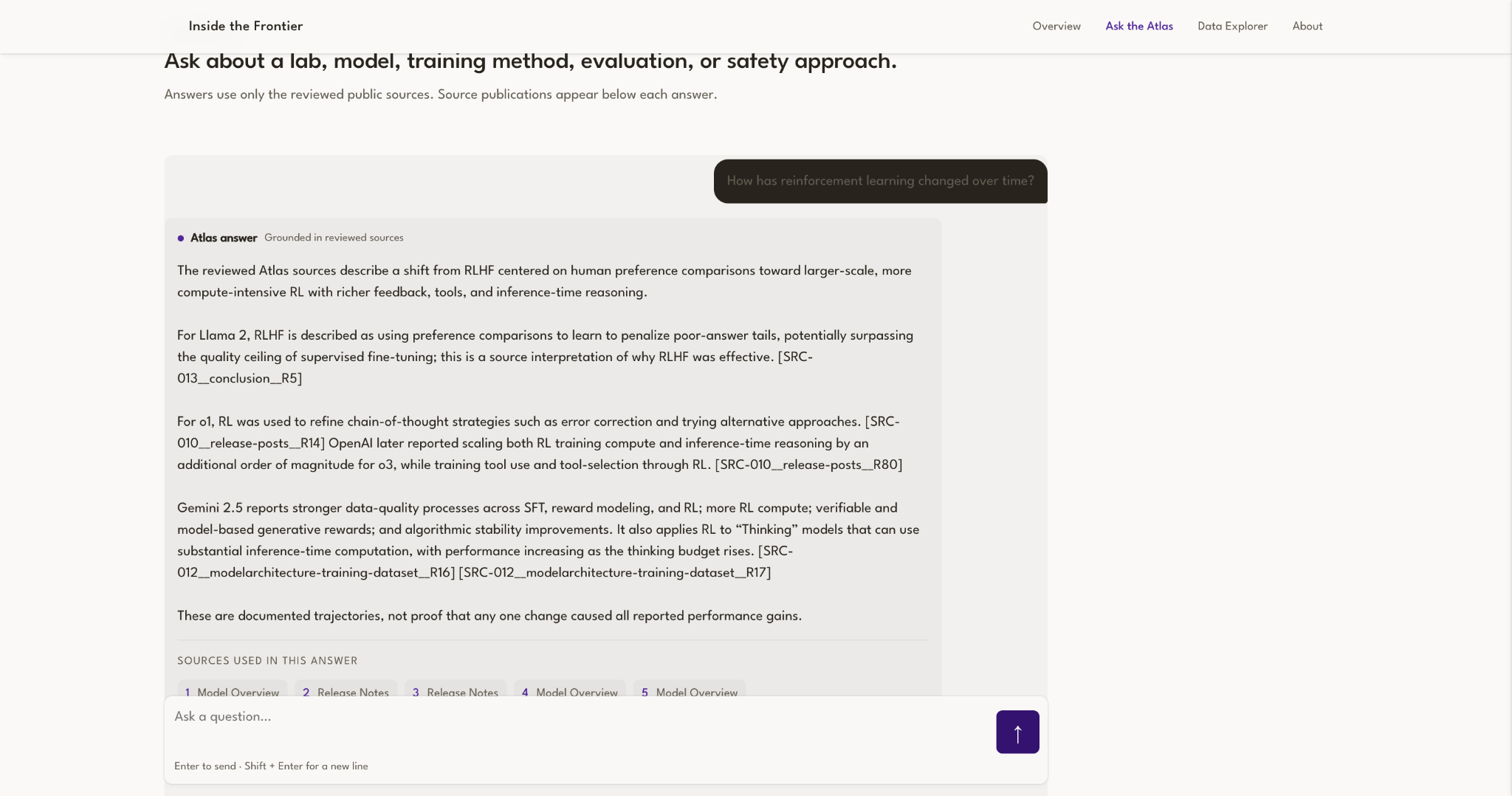
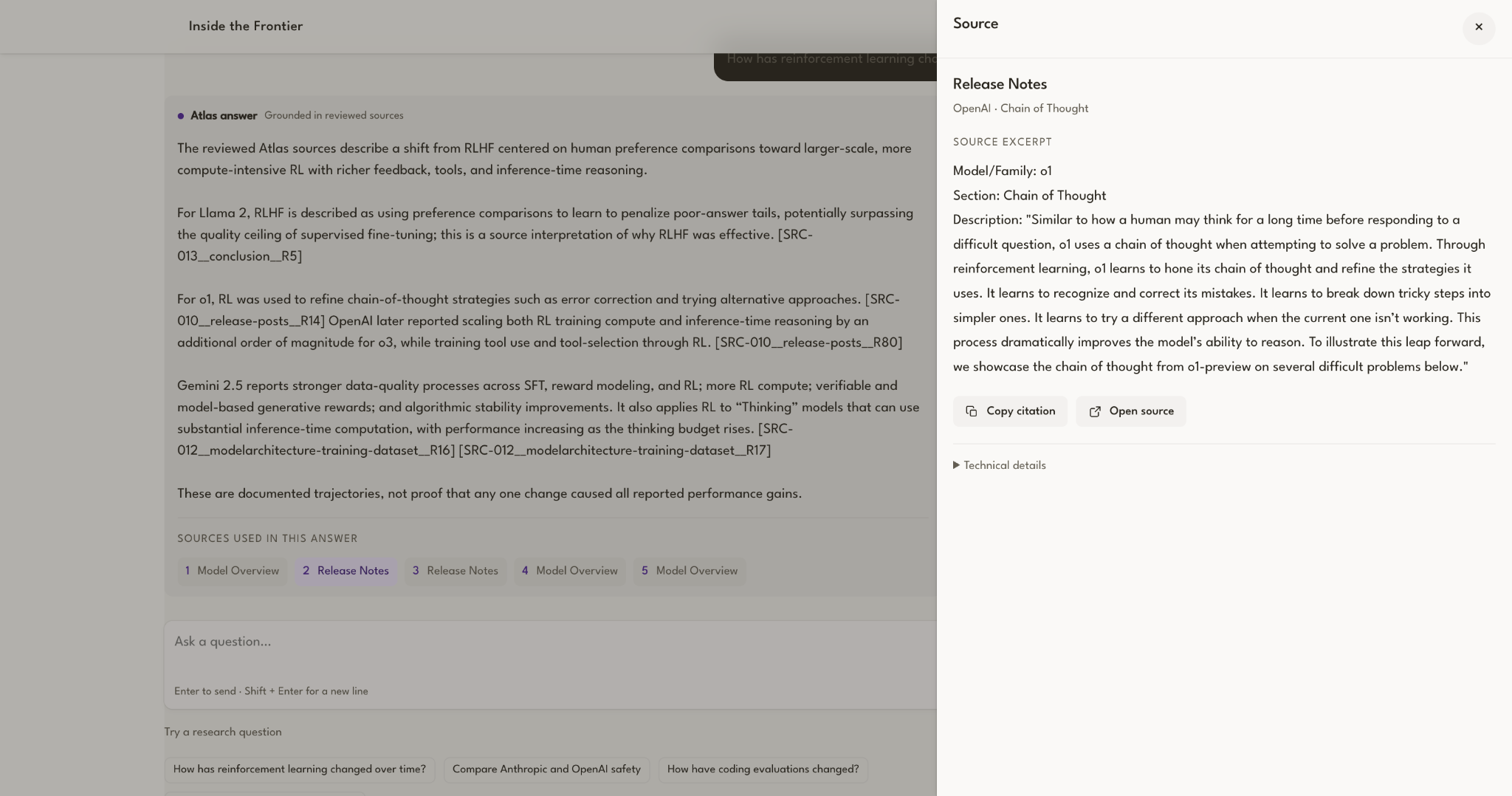
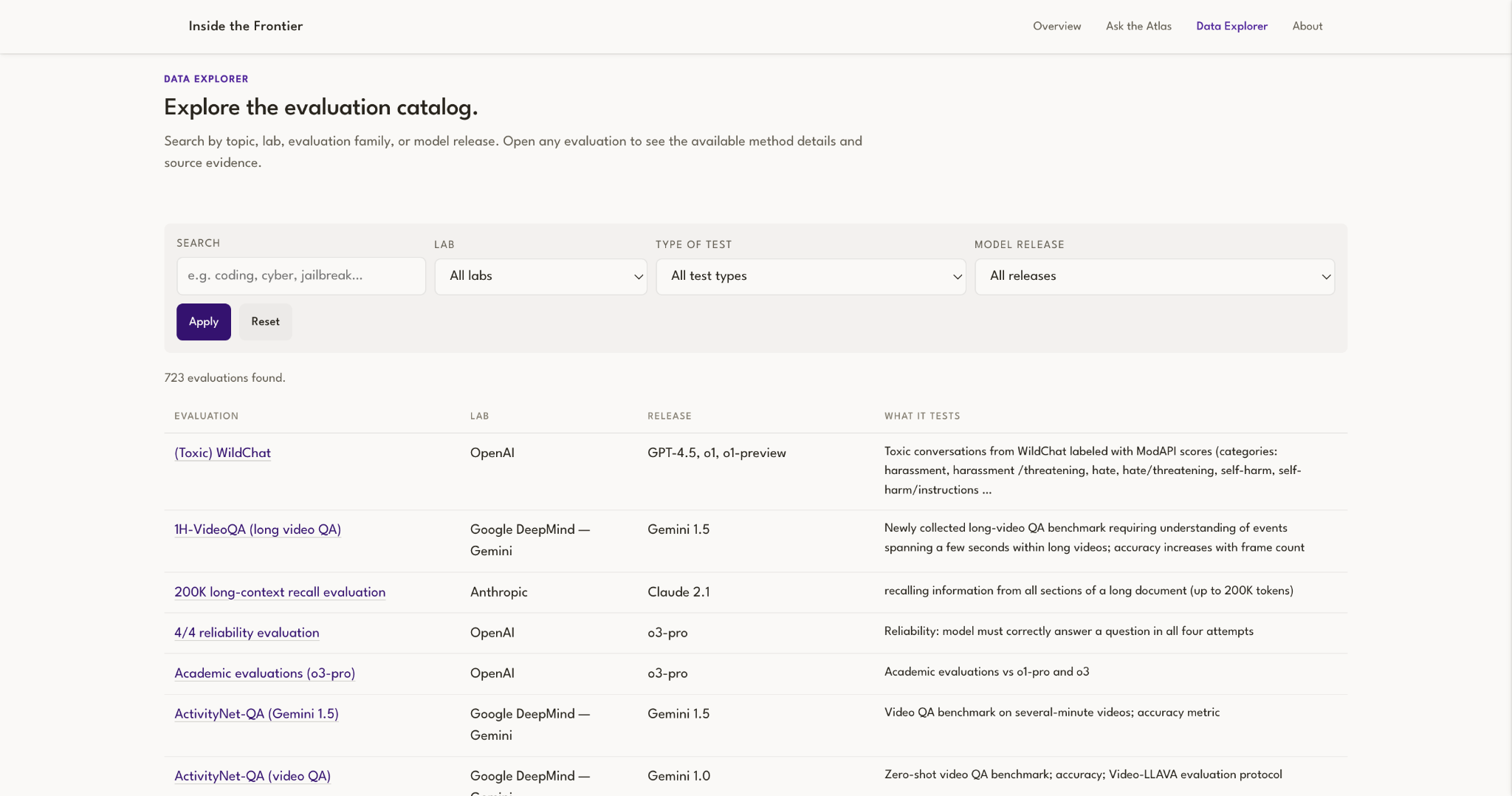
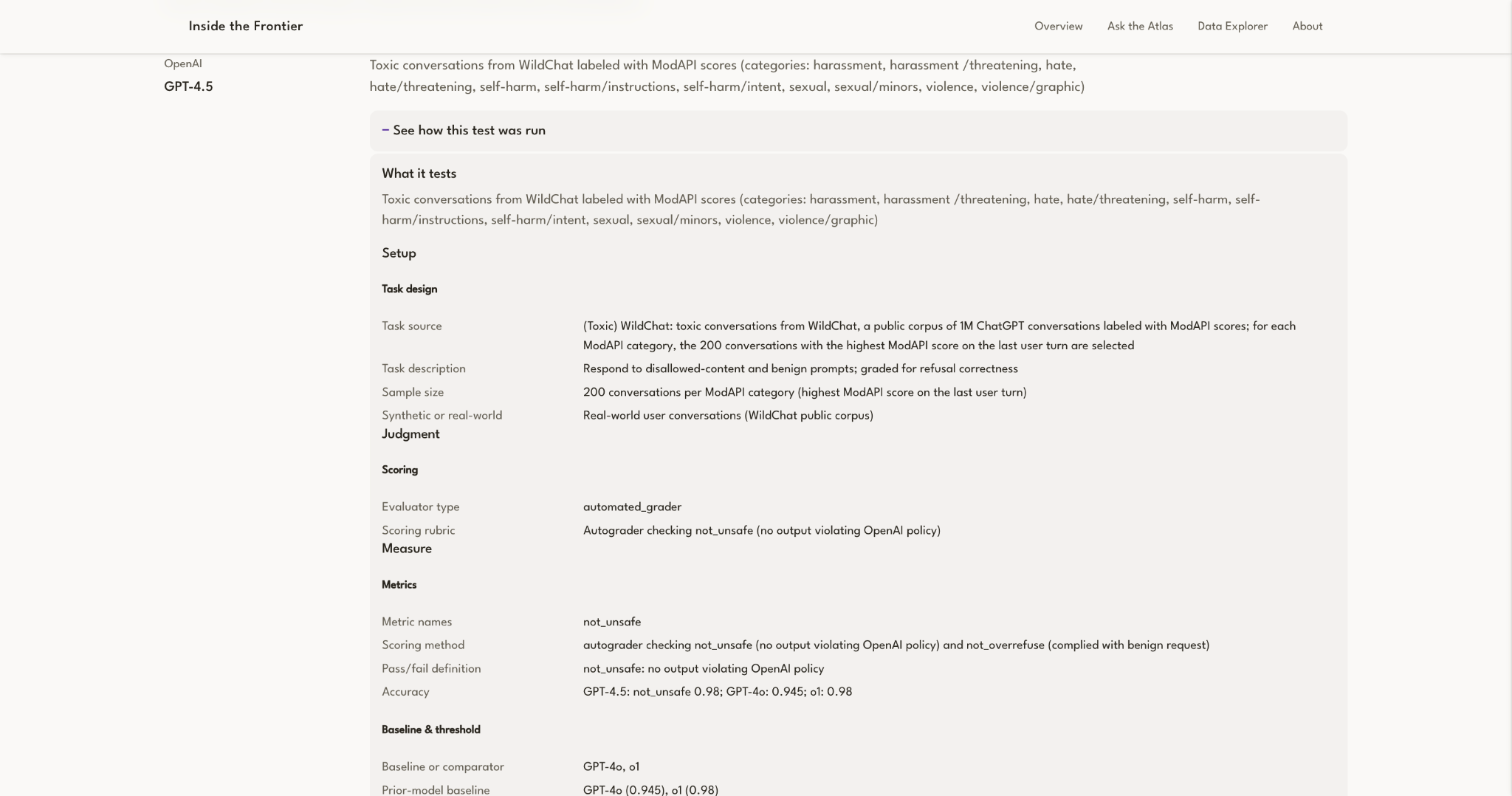
What this demonstrates: primary-source research, RAG and retrieval design, structured data extraction, AI evaluation literacy, safety and governance analysis, evidence auditing, and the ability to turn technical material into a product a non-researcher can use.
Next Steps
The deployed Atlas is intentionally bounded to the reviewed public record through August 2025. The next work is about testing the research product, not adding more pages.
Evaluate grounded QA
Build a question set and measure retrieval coverage, citation precision, unsupported-claim rate, and answer completeness.
Automate source deltas
Add a repeatable update pipeline for new system cards, model reports, and governance changes without rebuilding the corpus manually.
Surface comparability warnings
When two benchmark results use materially different protocols, make that warning visible before the user treats them as a direct model comparison.